
Garnet
Garnets have fascinated people for thousands of years. Although many people think of them as deep red stones, garnets actually come in nearly every color except blue. Their rich history, symbolism, and durability have made them favorites for both everyday jewelry and heirloom pieces.
What is a garnet?
Garnet is not a single gemstone but a family of closely related minerals. The most common varieties include:
Almandine – Deep wine red to burgundy; the classic garnet most people recognize.
Pyrope – Rich crimson red, sometimes called "Bohemian garnet."
Rhodolite – Raspberry or rose-red with purple undertones; especially prized for jewelry.
Spessartine – Bright orange to mandarin orange.
Tsavorite – Brilliant emerald-green and one of the most valuable garnets.
Demantoid – Rare green garnet famous for its exceptional brilliance.
Value
Garnets span an enormous price range.
Common red garnets (Almandine/Pyrope)
Beautiful jewelry-quality stones: approximately $20–150 per carat.
Exceptional stones: $150–400+ per carat.
Rhodolite garnets
Often $100–800 per carat depending on size and clarity.
Their raspberry color makes them particularly desirable for artisan jewelry.
Spessartine
Fine orange stones can range from several hundred to several thousand dollars per carat.
Tsavorite and Demantoid
Among the world's most valuable garnets.
Fine specimens often command thousands of dollars per carat.
For handcrafted jewelry like yours, the gemstone itself is only part of the value. The artistry, original design, sterling silver fabrication, and one-of-a-kind nature usually contribute more to the finished piece than the raw stone.
Symbolism
Few gemstones carry as much symbolism as garnet.
Throughout history, garnets have represented:
Strength and endurance
Protection for travelers
Deep friendship and loyalty
Love rooted in trust rather than passion alone
Courage during life's transitions
Vitality and life force
Ancient travelers often carried garnets as protective talismans, believing they would help them find their way home safely. Because of their glowing red color, garnets were also associated with the warmth of a hearth fire—a symbol of home, belonging, and safe return.
Garnets in nature
One reason garnets feel so appropriate in your work is that they are literally stones of the earth.
Garnets form under tremendous heat and pressure deep within the Earth's crust. They are commonly found in metamorphic rocks created by mountain-building processes. In many ways, they embody resilience: ordinary minerals transformed over immense spans of time into something durable and beautiful.
That geological story aligns naturally with your themes of authenticity, endurance, and the quiet strength found in nature.
Birthstone and anniversaries
Garnet is:
The traditional birthstone for January.
The gemstone associated with the 2nd wedding anniversary.
Its symbolism of lasting commitment makes it especially meaningful as a gift celebrating enduring relationships.
Why garnets work so beautifully in your jewelry
Nancy, as we've been shaping your collections, I've noticed that your work isn't about flashy gemstones. The stones serve the metalwork and the story.
Your Twigs & Tendrils collection is about growth, seasons, and the living landscape. A garnet in that context can suggest:
winter berries clinging to a branch,
seeds that promise renewal,
warmth carried through the cold months,
the quiet persistence of life.
That's one reason Winter Berries felt like such a natural name for your garnet necklace. The garnets become more than accents—they become part of the narrative.
You might even include a brief note in your product descriptions such as:
Garnets have long symbolized strength, protection, and enduring friendship. Their deep crimson color recalls winter berries that brighten the landscape, a reminder that beauty and resilience persist through every season.
That feels very much in harmony with your voice: grounded in nature, quietly poetic, and inviting the wearer to find personal meaning rather than making grand claims.

Types of Silver I Use
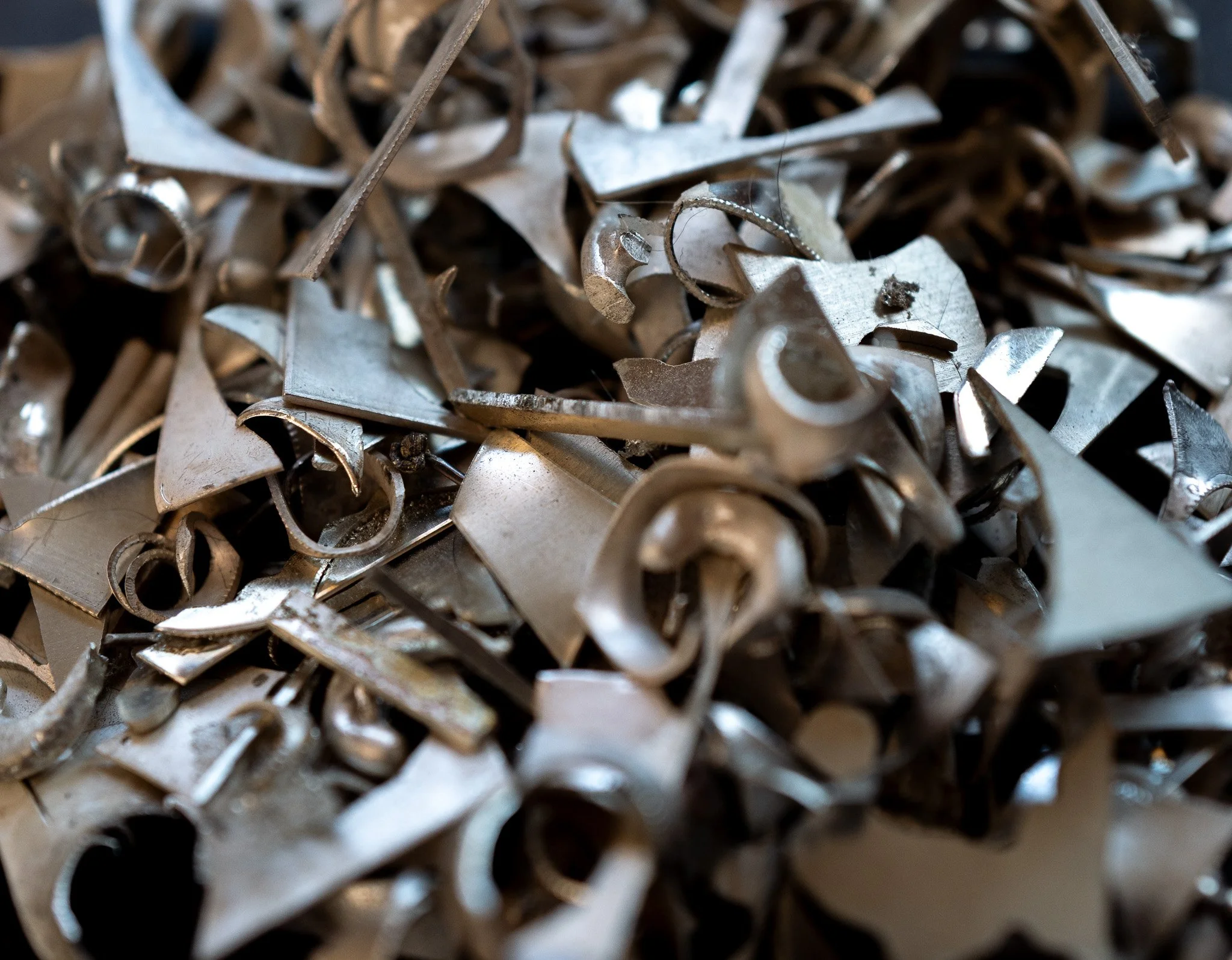
Sterling Silver
An alloy is a mixture of chemical elements of which at least one is a metal.
Sterling silver is an alloy of silver containing 92.5% by weight of silver and 7.5% by weight of other metals, usually copper.
A reason for creating a silver alloy is to add strength to the silver.
As the purity of the silver decreases, the problem of tarnishing increases, especially if atmospheric pollutants are present. Tarnish appears as a dull gray, or black film or coating over the metal.
Traditional silver has a melting temperature of 1640’F.
Argentium Silver
Argentium silver (originally patented in 1998) is a brand if modern, tarnish- resistant silver alloy, containing either 93.5% or 96% silver. Argentium alloys replace some of the copper in sterling silver with a metalloid, germanium.
The benefits of Argentium which help it stand out in the marketplace include:
Argentium does not firestain. (Firestain is a layer if oxides that become visible on the surface of objects made of metal alloys containing copper when they are heated. The oxides stain the polished surface and are undesirable in appearance)
Argentium is highly tarnish resistant.
Argentium is brighter and shinier than sterling silver.
Argentium is stronger than sterling silver.
Argentium silver is patented and trademarked by Argentium Silver Company, UK
Fine Silver
Fine Silver is defined by it’s purity. Any silver used for investment or trade on metals and commodities exchanges must be 99.9% pure.
Investment grade fine silver is stamped with a hallmark certifying it’s purity, 999.
Sterling silver used in jewelry has a purity of 92.5%. Thus, sterling silver jewelry is often stamped with 925.
Silver coins minted for general circulation use silver with a purity of between 80-90 percent.
Only fine silver is used in silver bullion and bullion coins. Only silver stamped 0.999 purity has value on the trade markets.
As used for jewelry personally, I enjoy the malleability of fine silver and the way it feels in my hands as I form it. I appreciate that oxides don’t discolor fine silver. Most of all I like the slightly imperfect surface that remains after building a piece, I don’t polish it away.
Turquoise, the Mineral
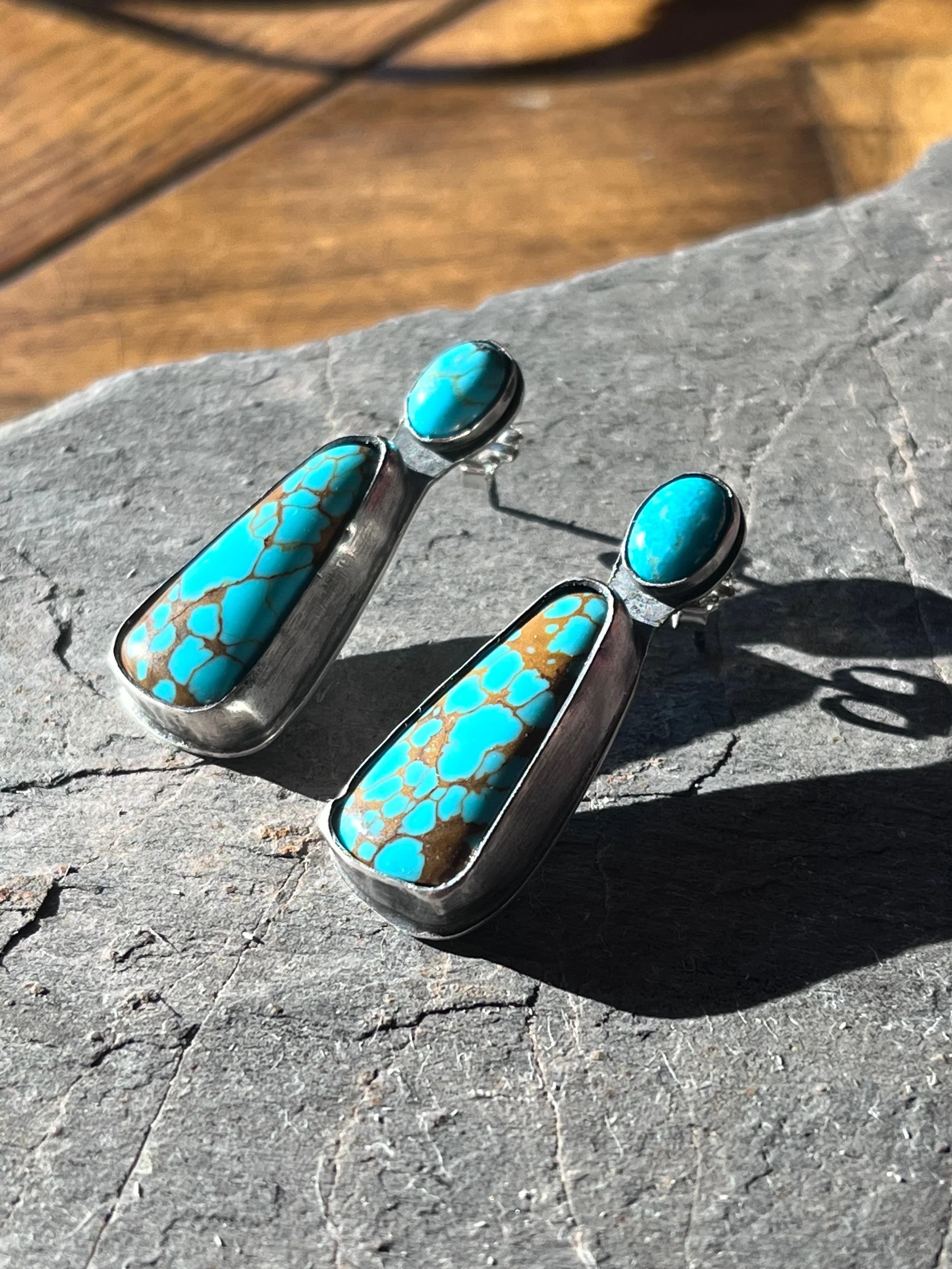
Turquoise is an opaque blue to green mineral classified as a hydrous phosphate. It was formed as water trickled through a host rock nearly thirty million years ago. Deposits containing copper, aluminum, and zinc were left behind in the host rock to form the beautiful gemstone, Turquoise.
The amount of copper in the mineral dictates the degree of blue that turquoise reveals. This color can range from pale powdery blue to dark blue, blue-green, matte-green, and dark green.
However, when greater levels of aluminum are present the color tends to be more green or white.
If zinc occurs naturally in the mix the color becomes a yellow-green and the stone becomes even harder.
Turquoise is rare and valuable in finer grades and has been prized as a gemstone and ornamental stone for thousands of years because of it’s unique color.
Turquoise has a hardness of 5-6 (Mohs hardness scale)

Aspen Grove
A beautiful rainbow in Western Colorado.
Aspen Grove on McClure Pass, Western Colorado
The Aspen Grove
At around 10,000 feet the temperature drops, and aspen trees begin to appear. The tall thin aspens with their smooth bark stretch like skin to the sky. The continuous rustle and shiver of their leaves is like an ocean of small voices arriving through the centuries. If only one could make out their cry, their song, and understand their brilliance.
Walking among them, touching them, listening to their creek and sway, one can feel their connectedness. Above ground, aspen grow as individual trees, but below ground they’re enlivened by one interconnected set of roots. They are the most expansive growth of trees to share a common root system. This means they are one living organism and one living community-at the same time.
Quaking Aspen, a particular species that grows where avalanches, mudslides and fires have occurred, is nature’s example of relational resilience. The grove roots and regenerates most strongly after disasters. In Yellowstone National Park, a quaking aspen grove grew out of the 1988 wildfires.
In Fishlake National Forest in Utah, there is an Aspen grove named Panda, Latin for “I spread”. Considered one of the largest aspen groves in the world, it contains 47,000 individual trees and is estimated to be about 80,000 years old. Shared roots live longer, a lesson for us all.
The aspen trees are a powerful metaphor for how inextricably knit the life of the individual is with the life of community.